
I’m a musical theater kid. While my high school friends spent their free time at jobs or practicing various sports, I could be found on a stage, in a rehearsal room, or standing in front of my bedroom mirror belting out standards from Funny Girl, Phantom of the Opera, Oklahoma! and The Music Man, among others.
Theater remained my focus through college, and I got close to the spotlight a time or two before letting go of that particular dream.
How does me being a theater kid have anything to do with copywriting?
This…
Bear with me for a minute and it will all make sense, I promise.
When I was first introduced to the art and craft of copywriting, I was immersed in the “gun-to-the-head” marketing of Gary Halbert. If you’ve never read his work, I encourage you to subscribe to The Gary Halbert Letter, which is still being run by his sons Bond and Kevin, and read Gary’s newsletters from “North of Jewfish Creek.” In them, you will see the seeds of many great direct response copy pieces still in use today.
You’ll also see why, although I reject much of the “gun-to-the-head” hype, the man was a genius communicator.
Halbert was a master of rhythm: of setting up a call and response on the page, repeating it just enough that your brain raced ahead to the payoff of the downbeat before you even knew you were doing it. Setting up subliminal assent and acceptance with almost symphonic precision.
Check out this excerpt from the landing page of The Gary Halbert Letter:
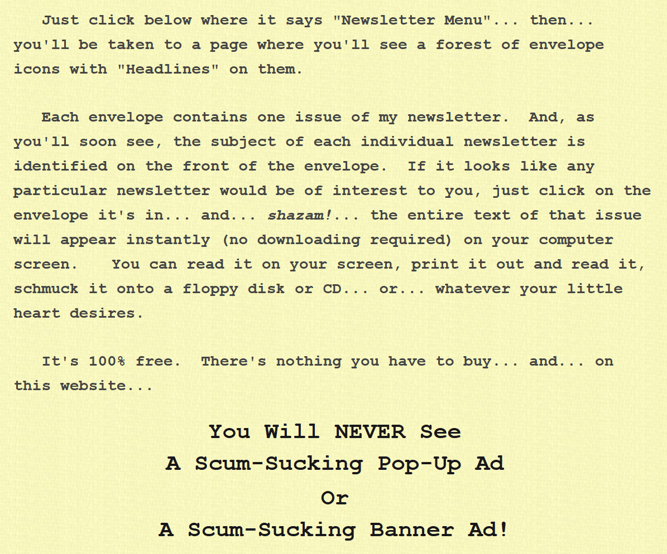
The use of ellipses, italics, parentheses, bolding, and white space are like musical notes, inviting us to follow the rhythm of his drum. And I won’t even get into his use of questions as commands and call and response in the space of this short blog post.
Much like Harold Hill (the con man in the video above), each of Halbert’s seemingly off-the-cuff rants or enthusiastic offers of assistance were carefully crafted, exhaustively researched, and tested prior to his larger audience ever receiving it.
And if you read Halbert aloud, the musicality of his phrasing shines through. Each offer is a patter song, just like Ya’ Got Trouble by Meredith Wilson, (Not) Getting Married Today by Stephen Sondheim, Guns and Ships by Lin Manuel Miranda, or I Am the Very Model of a Modern Major General by the progenitors of the genre in English operetta, Gilbert & Sullivan.
Humans are naturally music-loving, rhythmic creatures. We love toe-tapping, chanting, singing, and head banging to music that moves us. Love him or hate him, one of Gary Halbert’s great talents was his ability to write with musicality – and to conduct us through his symphony of language with unprecedented skill.
Now, I’m not saying to rush to the page and start modeling Halbert. What I’m saying is understanding how he used language gives you another tool when it comes to your brand messaging. Once you fully understand its architecture, you can reimagine it for your own purposes. Put your own spin on it, if you will (pun completely intended).
What examples of great patter writing have captured your imagination? I’d love to talk about them. Comment below to continue the conversation.
*I am not a paid advertiser for The Gary Halbert Letter nor have I received any compensation for this recommendation.

Leave a comment